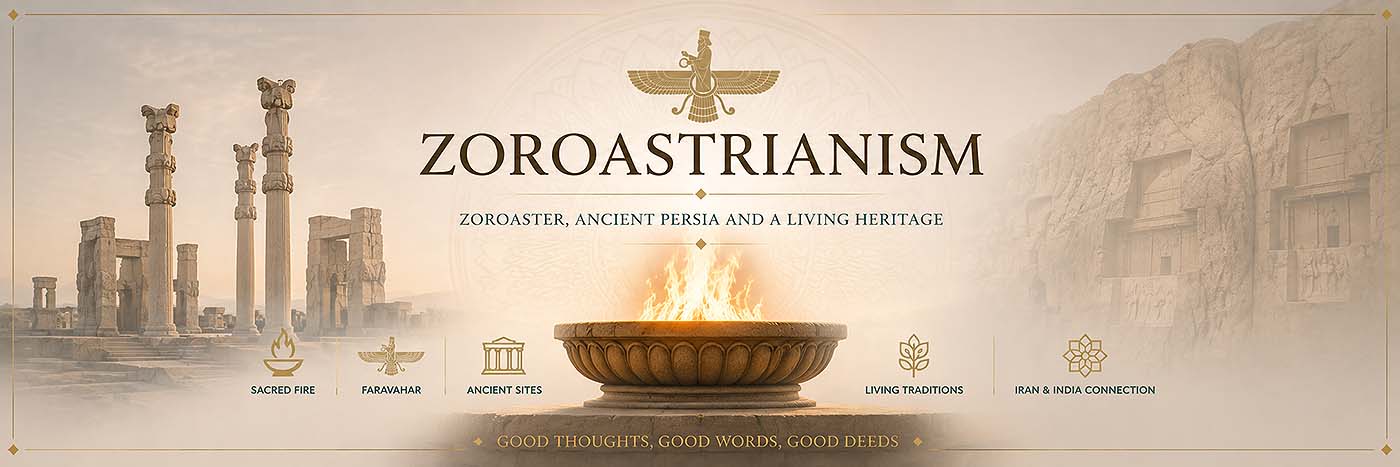
Zoroastrianism: Zoroaster, Ancient Persia and a Living Heritage
The Story of Zoroaster and the Origins of Zoroastrianism
Zoroaster: The Prophet Behind an Ancient Iranian Tradition
To understand Zoroaster and the world in which his teachings emerged, it is important to look beyond the political borders of modern Iran and consider the broader geographical and cultural landscape of the Iranian Plateau. Stretching across a vast region of West and Central Asia, the Iranian Plateau encompasses much of present-day Iran while extending into areas of modern Afghanistan, Pakistan and other neighbouring regions, with its boundaries varying according to geographical, geological and historical definitions. For thousands of years, this vast landscape was a meeting ground of peoples, languages, religions, trade routes and civilizations, and the cultural world of ancient Iran was never confined to the borders of a modern nation-state. Zoroaster therefore belongs to this wider Iranian world: a historical and cultural landscape shaped by mountains, highlands, deserts, fertile valleys and long-distance connections across Central and Western Asia. Understanding the Iranian Plateau in this broader sense allows Zoroaster to be placed within the historical environment from which the Iranian religious and cultural traditions developed, rather than retrospectively assigning an ancient figure to the political geography of the present day. Zoroastrianism is one of the world’s oldest religious traditions, rooted in the teachings of Zoroaster, or Zarathustra in its ancient form, a remarkable religious figure who lived in the ancient Iranian world. The exact date and birthplace of Zoroaster remain subjects of scholarly debate, and there is no universally accepted historical date for his life; however, linguistic and historical studies generally place him somewhere within the second or early first millennium BCE, making him a figure of extraordinary antiquity. The oldest texts associated with his own teachings are the Gathas, ancient hymns preserved within the Avesta, through which Zoroaster speaks about truth, wisdom, moral responsibility and the individual’s ability to choose between different paths. In the Zoroastrian tradition, his spiritual encounter with Ahura Mazda, the Wise Lord, became the foundation of a religious philosophy centred on truth, righteousness and conscious moral choice. Rather than presenting human beings as passive subjects of fate, Zoroaster’s teachings place responsibility upon the individual: every person participates in the struggle between truth and falsehood through thought, speech and action. This emphasis later became one of the defining characteristics of Zoroastrian ethics and would influence the religious and cultural history of Iran for centuries. For travellers visiting Iran today, understanding Zoroaster is therefore not simply an introduction to an ancient prophet; it is the beginning of a much broader journey into the history, philosophy and cultural heritage of one of the oldest civilizations in the world.
Ahura Mazda, Truth and the Choice Between Good and Evil
At the heart of Zoroastrian thought stands Ahura Mazda, the “Wise Lord” and the supreme source of wisdom and good creation. One of the fundamental concepts of this worldview is Asha, a term associated with truth, righteousness, proper order and living in harmony with what is right. Opposed to Asha is Druj, associated with falsehood, deception and disorder. From this perspective, human life is fundamentally a matter of choice. Human beings are not passive subjects of fate; through their thoughts, words and actions, they participate in choosing between truth and falsehood and thereby contribute to the moral direction of the world. 🔗 [Explore the philosophy of Zoroastrian ethics and the concept of Asha in greater detail.]
Spenta Mainyu and Angra Mainyu: The Two Opposing Paths
The Zoroastrian understanding of good and evil is closely connected with the concept of two opposing spiritual principles. In the Gathas, Spənta Mainyu, often translated as the “Holy,” “Bountiful” or “Creative Spirit,” stands in opposition to Angra Mainyu, the destructive or harmful spirit. These concepts appear within the framework of a fundamental choice between two paths, placing moral decision-making at the centre of human existence. In later Zoroastrian tradition, this opposition became more explicitly developed through the concepts of Ahura Mazda and Ahriman, with Angra Mainyu becoming increasingly associated with Ahriman, the destructive force opposed to good creation. It is important, however, not to treat these different historical stages as completely identical: the concept of Angra Mainyu in the Gathas is not exactly the same as the fully developed image of Ahriman found in later Zoroastrian texts. The distinction itself is an important part of understanding how Zoroastrian theology developed over time. 🔗 [Read more about Angra Mainyu, Spenta Mainyu and the Zoroastrian understanding of good and evil.]
Good Thoughts, Good Words and Good Deeds
One of the most widely recognised summaries of Zoroastrian ethics is the principle commonly expressed as “Good Thoughts, Good Words, Good Deeds.” The traditional formulation Humata, Hukhta, Huvarshta brings together good thinking, good speech and good action and expresses an important principle of Zoroastrian moral philosophy: goodness should begin in the mind, become visible through speech and ultimately be realised through human behaviour. Although the famous English formulation should not be presented as a direct quotation from the Gathas, it provides an effective summary of an ethical tradition in which individual responsibility and moral choice are fundamental. The significance of this principle extends far beyond the historical period in which Zoroaster lived. In a modern world still shaped by misinformation, conflict, environmental challenges and social responsibility, the idea that ethical life begins with what people think, continues through what they say and becomes meaningful through what they do remains remarkably relevant.
The Meaning and Historical Interpretation of the Faravahar
Among the symbols most strongly associated with ancient Iran and Zoroastrian culture, the Faravahar occupies a special place. The familiar image of a human figure emerging from a winged disk appears in ancient Persian art and has become one of the most recognisable symbols associated with Iran today. However, it should not simply be described as a “portrait of Zoroaster” or, without qualification, as a representation of Ahura Mazda. The ancient concept of the Fravaši in Zoroastrian texts has a much more complex spiritual meaning, associated with protective spiritual forces and with the spiritual dimension of human beings and ancestors. The Farvardin Yasht of the Avesta, for example, gives the Fravašis an important place in Zoroastrian religious tradition. At the same time, the precise interpretation of the winged-disk imagery found in Achaemenid art remains a subject of scholarly discussion. For travellers, this complexity is precisely what makes the symbol fascinating: what may initially appear to be a simple emblem opens the door to a much deeper story about ancient Persian art, Zoroastrian thought and the evolution of Iranian cultural identity. 🔗 [Discover the dedicated JeyTravel article on the Faravahar, its historical roots and its different interpretations.]
Zoroastrianism Through the Achaemenid, Parthian and Sasanian Periods
After Zoroaster, his teachings developed over many centuries and became intertwined with older Iranian religious traditions. During the Achaemenid period, inscriptions and historical evidence demonstrate the importance of Ahura Mazda and other elements associated with ancient Iranian religion, although the religion of the Achaemenid period should not simply be treated as identical to the fully developed Zoroastrianism of later centuries. Iranian religious traditions continued to evolve during the Parthian period, while under the Sasanians, Zoroastrianism became closely associated with the state and developed a highly organised religious establishment. Fire temples, priestly institutions, ritual systems, purity laws, sacred texts and theological traditions became increasingly structured during this period. This historical development is essential for understanding the Zoroastrian heritage encountered by travellers in Iran today, because not everything identified as “Zoroastrian” belongs directly to the time of Zoroaster himself; much of the visible heritage represents centuries of religious development, interpretation and adaptation within the Iranian world.
Sacred Fire, Purity and the Elements
Fire is one of the most recognisable elements of Zoroastrian religious tradition, yet the common statement that “Zoroastrians worship fire” is misleading. Fire has a sacred and symbolic role and is associated with light, purity, truth and spiritual clarity rather than being worshipped as a natural element or deity. Sacred fires are maintained within fire temples under specific ritual conditions, with priests and fire-keepers responsible for their care. The maintenance of a sacred fire is therefore not simply a matter of keeping a flame alive; it is part of a religious system in which purity, discipline and respect for creation are deeply connected. 🔗 [Learn more about Zoroastrian sacred fire and the traditions of fire temples.]
Fire, Water, Earth and Air
Respect for fire exists within a broader Zoroastrian concern for the purity of creation. Water, earth and air also have an important place within the religious worldview, and the avoidance of pollution of these elements became particularly significant in traditional Zoroastrian ritual practice. This principle can be especially clearly appreciated at historical sites where sacred fire, natural water and the surrounding landscape exist together. Takht-e Soleyman in northwestern Iran provides one of the most remarkable examples: the Sasanian Zoroastrian sanctuary was built around a natural volcanic lake and included a major fire temple associated with the sacred fire of Azar Goshnasp. UNESCO recognised the site as a World Heritage property in 2003, highlighting its extraordinary combination of natural features, religious significance and Sasanian architecture. 🔗 [Read the JeyTravel article about Persian sacred landscapes and the UNESCO World Heritage Site of Takht-e Soleyman.]
Zoroastrian Prayer and the Significance of Light
Zoroastrian prayer differs considerably from Islamic prayer and does not have a single fixed direction of prayer equivalent to the Islamic qibla. Light plays an important symbolic and practical role in Zoroastrian worship, and worshippers may face a source of light such as a sacred fire, the sun or natural light. This does not mean that the sun or fire is worshipped as a deity; rather, light provides a focus for prayer and represents purity, wisdom and truth. Religious practice also includes the wearing of the sacred Sudreh and the tying of the Kushti, a ritual cord accompanied by prayers. These practices form part of Zoroastrian religious identity and are particularly significant during important stages of life and religious ceremonies.
Marriage, Clothing and Ceremonies
Zoroastrian life-cycle ceremonies include rituals associated with birth, religious initiation, marriage and death, each containing its own prayers and customs. Zoroastrian marriage is traditionally conducted in the presence of a priest and family members and includes specific religious rites, while white clothing is commonly associated with purity and ceremonial occasions. The Sudreh and Kushti remain important symbols of religious identity, while family and community play an important role in maintaining traditions. For travellers interested in living heritage, these customs are particularly valuable because they demonstrate that Zoroastrianism is not simply an archaeological subject but a living tradition practiced by communities in Iran and around the world.
Festivals and the Continuity of Ancient Iranian Traditions
The Iranian calendar preserves a remarkable collection of ancient festivals, several of which have important connections with pre-Islamic Iranian traditions and Zoroastrian culture. Nowruz is the most prominent example: although the modern celebration should not be described simply as a “Zoroastrian religious festival,” its roots extend deep into the ancient Iranian cultural world and it has survived as a national and cultural celebration across centuries. Mehregan and Sadeh are other important festivals associated with ancient Iranian traditions and preserved particularly strongly within Zoroastrian communities. Sadeh has a powerful connection with fire and light, while Mehregan is associated with Mithra, autumn and ancient Iranian seasonal traditions. Chaharshanbe Suri provides another example of cultural continuity, particularly through its association with fire and symbolic renewal, although the modern festival should not be presented as a direct and unchanged Zoroastrian religious ceremony. 🔗 [Explore the JeyTravel article about Nowruz and its ancient Iranian roots.]
Yazd Fire Temple: A Flame with More Than 1,500 Years of Tradition
The Yazd Fire Temple is one of Iran’s most important Zoroastrian sites and one of the country’s best-known destinations for travellers interested in Zoroastrian heritage. The present building was constructed in 1934, but the sacred fire kept within the temple is traditionally associated with a history extending back more than 1,500 years, with its origins linked to the Sasanian period. The fire is known within the Zoroastrian tradition as an Atash Bahram, or “Victorious Fire,” and its history is one of the most remarkable stories of continuity within the Zoroastrian community of Iran. According to historical accounts preserved by the Zoroastrian community, the fire was originally associated with the Karyan fire temple in the Lar region of Fars. Following historical changes, it was moved for protection and continuity and eventually reached Aqda, where tradition states that it was maintained for around 700 years. In 1173 CE, it was moved from Aqda to the Nahid-e Pars fire temple near Ardakan, where it remained for approximately three centuries. In 1473 CE, it was transferred to Yazd and for a period was kept in the home of the prominent priest Tirandaz Azargoshnasp before finally being moved to the present fire temple after its construction in 1934. 🔗 [Discover the detailed JeyTravel article about the Yazd Fire Temple and the journey of its sacred fire.]
The Care of the Sacred Flame
The significance of the Yazd fire is not simply the number of centuries associated with it. Its importance lies in the continuity of a tradition through which generations of Zoroastrians have cared for a sacred flame and preserved its ritual meaning. The fire is maintained under the supervision of Zoroastrian priests and fire-keepers, with specific practices governing its care, fuel and ritual purity. For visitors, one of the most meaningful aspects of the experience is that the sacred fire is not merely displayed as an archaeological object in a museum; it remains part of an active religious tradition. Standing before the flame, travellers can therefore encounter a living symbol of purity and continuity, while learning how the fire was preserved and transferred through places such as Aqda, Ardakan and Yazd. For those travelling with an experienced cultural guide, the story transforms the visit from a simple sightseeing stop into an opportunity to understand how a small religious community preserved an important element of its identity across many centuries.
A Living Heritage in Front of the Visitor
Today, visitors to the Yazd Fire Temple can experience a remarkable connection between the ancient and the contemporary. The flame is still maintained as a sacred fire, and visitors may have the opportunity to see the fire and learn about its ritual care while respecting the boundaries established for the religious site. For travellers from the Parsi community in India, the experience can be particularly meaningful: the flame represents not simply an ancient monument in Iran but part of a religious heritage that survived through migration and continues to connect communities in Iran and India. JeyTravel’s specialised cultural journeys can incorporate the Yazd Fire Temple into a broader Zoroastrian heritage itinerary, with knowledgeable guides explaining the history of the fire, its journey through Iran, the role of priests and fire-keepers, and the continuing significance of sacred fire within Zoroastrian tradition.
Takht-e Soleyman and Azar Goshnasp: A UNESCO World Heritage Site
For understanding Zoroastrianism during the Sasanian period, few destinations in Iran are as significant as Takht-e Soleyman in West Azerbaijan Province. Located within a dramatic volcanic landscape, the site is centred around a natural lake and preserves the remains of a major Zoroastrian sanctuary, a fire temple associated with Azar Goshnasp, the Temple of Anahita and a Sasanian royal complex. During the Sasanian period, Takht-e Soleyman was one of the most important Zoroastrian pilgrimage centres in Iran and the home of Azar Goshnasp, one of the great sacred fires associated with the Sasanian royal and military establishment. UNESCO inscribed Takht-e Soleyman on the World Heritage List in 2003, recognising its exceptional historical, archaeological and cultural significance. 🔗 [Explore the JeyTravel guide to Takht-e Soleyman and its UNESCO World Heritage significance.]
Azar Goshnasp and the Sasanian Kings
Azar Goshnasp was particularly associated with the warrior class and the royal establishment, and Sasanian rulers are believed to have visited the sanctuary as part of their religious and political traditions. The importance of Takht-e Soleyman lies not only in the surviving ruins but in the extraordinary relationship between fire, water, volcanic landscape, religious architecture and royal power. For travellers interested in Zoroastrian heritage, visiting this UNESCO World Heritage Site provides an opportunity to experience one of the most important surviving landscapes of ancient Iranian religious history. JeyTravel can include Takht-e Soleyman and the remains of the Azar Goshnasp sanctuary within specialised Zoroastrian and ancient Persian heritage journeys.
Sky Burial, Dakhmas and the Zoroastrian Understanding of Death
One of the most distinctive aspects of traditional Zoroastrian practice is the way the dead were historically treated after death. In traditional Zoroastrian thought, the corpse could become a source of ritual pollution, making contact with earth, water and fire a serious religious concern. For this reason, many Zoroastrian communities historically used exposure, sometimes referred to as “sky burial,” rather than placing the body directly into the ground. The body was taken to a dakhma, commonly known in English as a Tower of Silence, where natural processes involving sunlight, wind and birds allowed the body to decompose without contaminating earth or water. The practice should not be reduced to the idea of an unusual burial method; it reflects a broader Zoroastrian concern with protecting the purity of creation. 🔗 [Read the JeyTravel article about Zoroastrian dakhmas, sky burial and the philosophy of purity.]
Why Sky Burial Declined
Traditional exposure has largely disappeared among Zoroastrians in Iran as social, legal, urban and religious circumstances changed, and burial in cemeteries became the accepted practice. The historic dakhmas of Yazd and other parts of Iran therefore remain important cultural and archaeological sites even though they are no longer generally used for traditional exposure in Iran. For visitors, the value of these sites lies in understanding the philosophy behind them rather than simply observing an unusual historical custom: the relationship between death, purity, the elements and the responsibility to protect the natural world reveals an important dimension of Zoroastrian thought. A specialised cultural tour should present this subject respectfully, avoiding sensationalism and treating the dead, the Zoroastrian community and the sacred character of these places with appropriate sensitivity.
Yazd, Kerman, Taft and Ardakan: The Living Geography of Zoroastrians in Iran
Zoroastrian heritage in Iran extends far beyond ancient ruins and fire temples. Yazd and Kerman have historically been among the most important centres of Zoroastrian life, while Taft, Ardakan and several villages and settlements in the surrounding regions preserve important connections with Zoroastrian communities and traditions. Historic houses, fire temples, shrines, gardens and local customs can reveal aspects of everyday Zoroastrian life that cannot be understood through monuments alone. Visiting such communities requires sensitivity and respect for privacy, but when properly arranged, these encounters can offer travellers a rare opportunity to understand how an ancient religious tradition continues to exist within contemporary Iran.
The Migration to India and the Parsi Community
Following the Arab conquest of Iran, groups of Zoroastrians gradually left Iran over the course of several centuries and migrated to India. The history of this migration was not a single event, and the traditional Parsi account preserves the story of the settlement of Zoroastrians in Sanjan in Gujarat. Over time, a distinctive Zoroastrian community developed in India and became known as the Parsis. The community later became particularly prominent in Mumbai and other parts of India and played an important role in the country’s commercial, industrial, educational and cultural history.
Iran and the Parsi Heritage
India remains one of the most important centres of Zoroastrian life outside Iran, and the Parsi community, despite its relatively small population, has preserved a remarkably rich cultural and religious heritage. For many Parsis, Iran represents more than a foreign destination: it is the historical homeland associated with the roots of their religious tradition and the homeland from which their ancestors eventually migrated to India. A journey through Yazd, Kerman, Taft, Ardakan and other Zoroastrian heritage sites can therefore become a deeply personal cultural experience, connecting contemporary Parsi identity with the landscapes, communities and traditions of Iran.
Zoroastrians Today and Their Global Community
Estimating the exact number of Zoroastrians in the world is difficult because population figures vary according to census methods, self-identification, interfaith marriage, migration and the distinction between religious and cultural identity. Iran and India remain the two historic centres of Zoroastrian life, while significant Zoroastrian communities also exist in countries such as the United States, Canada, the United Kingdom and Australia. Although the global Zoroastrian population is relatively small, its historical influence is much greater than its numerical size might suggest. Zoroastrians and Parsis have made significant contributions to business, industry, medicine, education, culture and public life in several countries, demonstrating how a small community can maintain a distinctive identity and contribute to wider society.
Zoroastrian Heritage Beyond Iran
Zoroastrianism occupies an important place in the history of religions and in the intellectual history of the Iranian world. Concepts associated with moral choice, truth and falsehood, good and evil, the afterlife and the eventual renewal of creation have attracted considerable scholarly attention in relation to the development of later religious traditions. Researchers have debated the extent and mechanisms of possible influence between Zoroastrianism and other religious traditions, particularly during periods of contact between Iranian, Jewish, Christian and later Islamic cultures. Such relationships should be described carefully, because similarities between religions do not automatically prove direct borrowing; nevertheless, Zoroastrianism remains one of the world’s earliest religious traditions with a highly developed ethical and cosmological framework, and its place in the history of Iranian civilisation and intercultural exchange is undeniable.
Experiencing Zoroastrian Heritage with JeyTravel
Understanding Zoroastrianism in Iran cannot be achieved through a few isolated visits to a fire temple or archaeological site. Its heritage developed across thousands of years and is distributed across different landscapes, cities and living communities. A specialised journey can begin in Yazd, where travellers can encounter the Fire Temple, the sacred fire, historic dakhmas and the contemporary Zoroastrian community, continue through Taft and Ardakan and their historic Zoroastrian heritage, explore Kerman and its surrounding traditions, and eventually reach Takht-e Soleyman, the UNESCO World Heritage Site associated with the great Sasanian fire of Azar Goshnasp. Along such a journey, an experienced guide does more than provide dates and names: the guide connects the places into a coherent story, explaining how Zoroaster’s teachings developed into a religious tradition, how sacred fire was maintained, why traditional funerary practices developed, how Zoroastrian communities survived in Iran and how part of the community eventually migrated to India.
JeyTravel is prepared to design specialised private Zoroastrian heritage journeys for international travellers, families and particularly members of the Parsi community in India who wish to explore the Iranian roots of their religious and cultural heritage. These journeys can be tailored around religious heritage, history, architecture, photography, pilgrimage or family and cultural interests, with the possibility of selecting male or female guides and multilingual guiding according to the needs of each group. The purpose is not simply to visit “Zoroastrian attractions,” but to create a meaningful narrative connecting Zoroaster, ancient Persia, Zoroastrian philosophy, sacred fires, historic communities, the migration of Parsis to India and the living heritage that remains in Iran today. For a Parsi traveller arriving in Iran, such a journey can become a form of cultural return: standing before the sacred fire in Yazd, walking through historic Zoroastrian landscapes, visiting the dakhmas and communities of central Iran, hearing the story of migration to India and eventually reaching Azar Goshnasp at Takht-e Soleyman can transform a conventional holiday into a journey through identity, memory and heritage. 🔗 [Discover JeyTravel’s specialised Zoroastrian heritage journeys in Iran.]
A Living Heritage, Not Only an Ancient Memory
Zoroaster lived thousands of years ago, yet the ideas associated with his teachings have not remained confined to the distant past. A sacred fire is still maintained, Zoroastrian communities continue to preserve their religious traditions, Parsis in India continue to maintain their distinctive cultural identity, and places such as Yazd and Takht-e Soleyman still allow travellers to encounter physical landscapes connected with this ancient tradition. Perhaps this is the most meaningful reason to explore Zoroastrian heritage in Iran: its history is not found only in books or museums. It remains visible in fire, architecture, landscapes, festivals, symbols, communities and living traditions, offering travellers an opportunity to experience one of the deepest layers of Iran’s cultural history.